
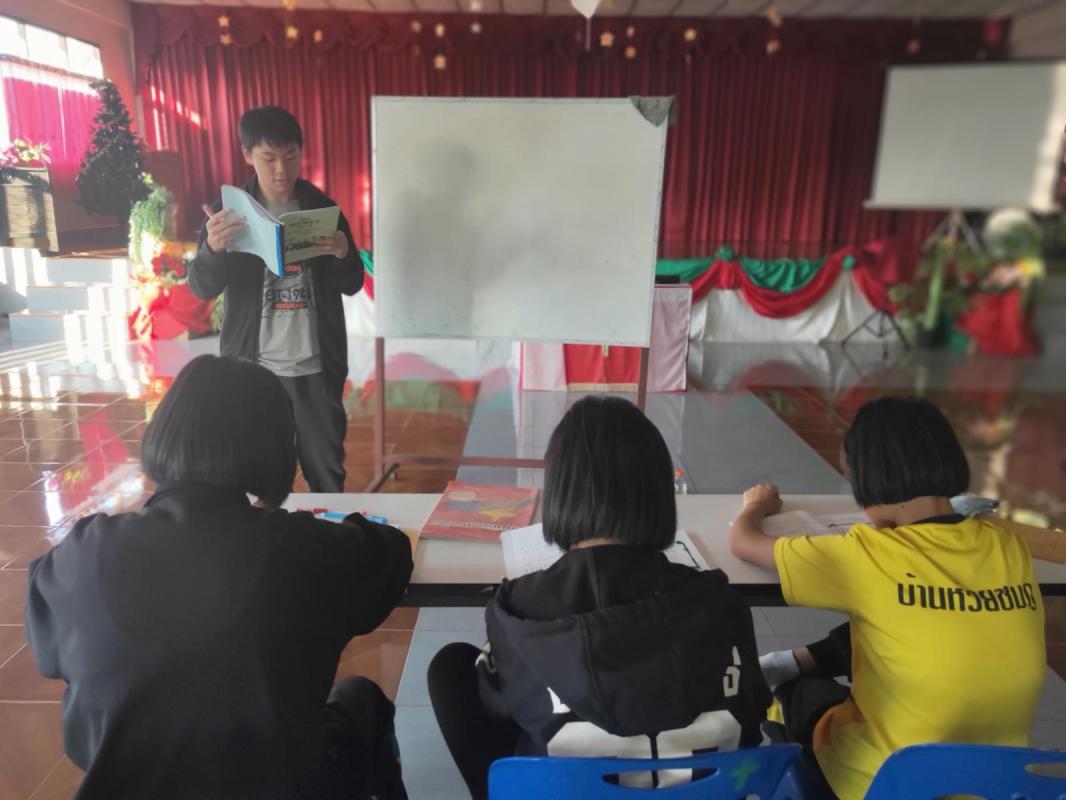

Helping villagers at Chiang Rai 2019
Inspire
I was inspired by the rather personal and heartfelt sharing from the previous participants when the applications for Overseas Community Involvement Programme (OCIP) opened. Many of my seniors suggested that I should participate in, and cited that their experience during the trip allowed them to widen their view of the world and learn more about the way of life in Thailand, and benefit villagers in a positive way.
Learn & Decide
Through a sharing by the previous batch of participants, I had learned that the place was one of the poorest regions in Thailand, and many of the villagers suffer from poverty. The education level of the villagers was not high and some were barely literate. The children receive limited education as the student-to-teacher ratio is very large.
As a student that has been given the chance to receive a good education, I thought that I would be able to reach out and teach the kids phonics and language while making the classes fun and interactive. I also thought that helping to build roads in the village will help make their daily commute safer and to their convenience.
Do
The teachers-in-charge of the trip held a briefing for both the participants and the participants’ parents, which informed us about the situation over at the village we were helping, as well as the activities we were conducting there, namely road paving, mural painting, and teaching kids.
Prior to the trip, all the participants met up for a few preparation sessions to discuss and plan the conduct of the activities that we were going to carry out there. We organised ourselves into groups in charge of bible storytelling, mural painting, and a cultural performance.
Being a member of the mural painting group, I had to sketch and design a physical drawing of a mural with my team members which would be painted over at the village. After spending time sketching some drafts, we managed to settle on a design that we thought would be a lively addition to the village.
Other than designing the mural, I was also largely involved in the bible storytelling and cultural performance portions. For the case of the bible storytelling, I played ‘Jesus’ in the Reenaction of ‘Jesus calms the storm’. We worked extensively to design, produce and paint props such as a boat, a wooden cross, and waves made out of cardboard for the reenaction. I was also involved in the making of the script and the lines were carefully written to make the performance easy to understand. My group and I created stage cues and actions for certain sections of the play so that it would be more vibrant and appealing to our audience.
Throughout the preparation sessions, we practiced the reenaction several times and multiple revisions to the script were made by us based on our rehearsals, ensuring that the kids at the village could understand and enjoy the short reenaction. Through this experience, I learned the importance of empathy and communication as a member of the planning committee.
As for the cultural performance, I was in the group that represented the Chinese culture, aside from the other two major races in Singapore. We had to brainstorm ways to portray the Chinese culture via demonstrating certain Chinese customs or through retelling traditional Chinese legends, eventually settling for the story of ‘nian(年)’, which is the reason why the Chinese believe red is auspicious. We also decided to include a segment about the Chinese custom of bai nian(拜年). For the story of ‘nian(年)’, I played the ‘nian’, a monster that scared off villagers. We made an effort to ensure that the performance would be smooth by designating signals for people to appear and leave, and including actions to make the performance entertaining. When I was writing the script along with my group, I paid special attention to the language used so as to convey the right emotions and give the villagers a good impression of the culture. Similarly, we rehearsed our lines extensively and made changes whenever it was necessary. We tediously spent a sizeable amount of time making the decorations and props, especially the 'nian' mask which required multiple coats of paint and the red firecrackers.
These activities required planning on my end to ensure that the running of the activities was smooth.
I managed to interact with the local community there during the course of the trip, especially with the children. We got to know more about their family backgrounds and struggles they face living in such a rural location. We were also given the chance to pave a road that connects a school to the rest of the village, with the help of the local villagers.
Share
During the trip, we had to complete a short reflection every day that was related to the trip. For example, ‘How has the community positively impacted you?’ and ‘What is one thing you can do for the community’. We were encouraged to share our experiences and thoughts with our peers and teachers throughout the course of the trip.
Also, each of us wrote a note to a participant next year, which included our well wishes and feelings towards the trip. I would like to share my stories about this trip with my peers and family, and encourage my juniors to participate in this trip next year.


