
Green Skills for Youth-Led Climate Action
This project was inspired by the growing environmental challenges faced by communities in Ecuador, such as deforestation, pollution, and biodiversity losscombined with the strong motivation of young Scouts to take action but the need to further strengthen their skills to do so effectively. The initiative builds on insights and commitments expressed by young people during national youth forums and Scout educational processes, which highlighted responsible consumption, environmental education, and community action as priorities. Green Skills – Champions for Nature was created to transform this motivation into concrete, youth-led actions by equipping young people with practical green skills, structured project management tools, and opportunities to lead meaningful environmental initiatives that generate lasting impact in their communities.
The project was implemented nationwide across the 17 provinces of Ecuador where the Scout Movement is present, reaching both urban and rural communities. Its execution was organized in sequential phases aligned with the project objectives. The first phase focused on a national awareness campaign on responsible consumption, where monthly challenges and learning activities were proposed to Scout groups to promote sustainable habits. Participants were encouraged to share their achievements on social media using the campaign hashtag, generating strong digital engagement and amplifying the project’s visibility at national level.
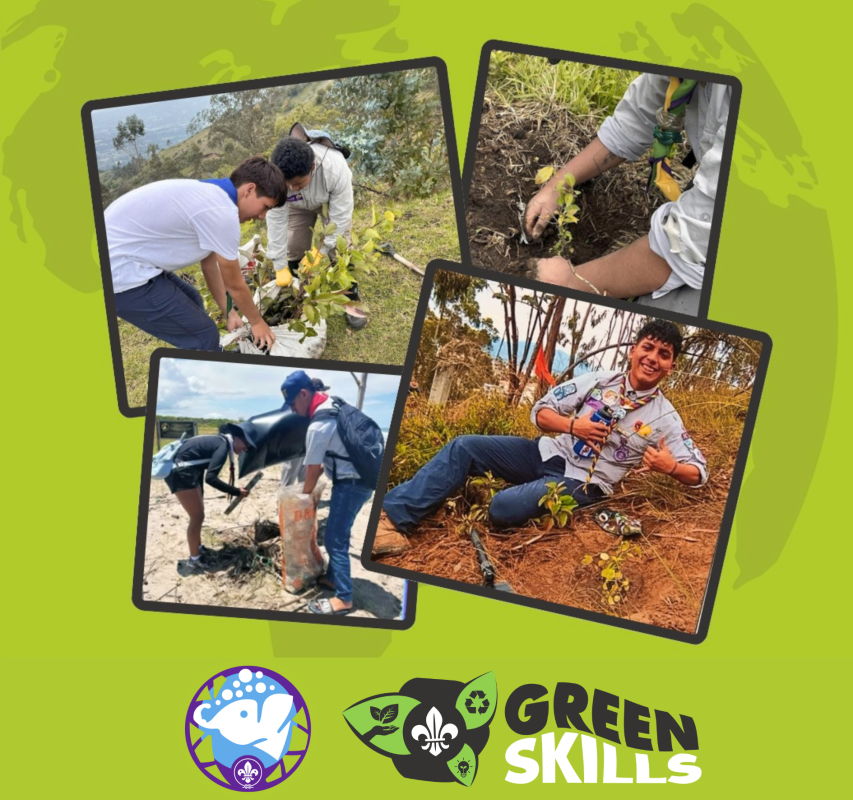
In the second phase, Scout groups were motivated to design and implement local environmental actions, including reforestation activities, clean-ups of beaches, rivers, parks, and other green areas. This phase culminated in a large-scale national call to action known as the Eco-limpiatón, carried out simultaneously on September 20, mobilizing more than 1,600 Scouts from multiple cities across the country. The Eco-limpiatón was implemented in coordination with municipalities, local authorities, private companies, and community members, strengthening multi-sector collaboration and community ownership.
The final phase of the project focused on capacity building through a national training program delivered in both in-person and virtual formats, reaching more than 200 Scouts from different provinces. This training aimed to strengthen green skills, deepen knowledge of the Earth Tribe – Champions for Nature Challenge, and introduce design thinking tools for the creation of innovative, youth-led environmental project proposals.
The project was led by a core team of 15 young people who played a central role in planning and implementation in coordination with the National Scout Office. Additional technical support was provided by consultant Monserrath López through a WOSM service, who accompanied the project from its early stages and contributed to the design and delivery of the training workshops, including in-person participation in the first national workshop in Quito. The project was made possible thanks to funding provided by UNICEF through World Scouting. Furthermore, the project achieved significant impact on social media through the support of Louann Gouard, a French civic service volunteer from Scouts et Guides de France, who led the design and implementation of the communication strategy throughout the project year. Strong partnerships with public and private sector actors at local level further enabled Scout groups and districts to implement well-coordinated actions and achieve the project’s overall goals.
The project achieved a strong national impact by significantly expanding youth-led environmental action and awareness across Ecuador. It directly engaged 2,348 Scouts (1,924 young people and 424 adults), exceeding the original target of 2,000, and indirectly reached 7,513 additional Scouts through educational materials and information dissemination. In total, the project reached 9,861 Scout beneficiaries nationwide.
At community level, the impact extended well beyond the Scout Movement. Through environmental actions, awareness campaigns, and large-scale clean-up activities, the project reached 46,393 non-Scout community members, far surpassing the initial target of 10,000. Digital awareness efforts alone reached 34,124 people, increasing public understanding of responsible consumption and environmental care.
In terms of concrete environmental results, 142 community actions were implemented across the country. While slightly below the numerical target, many actions were large-scale interventions that significantly amplified impact. The project resulted in the planting of 4,195 trees, the restoration or cleaning of 36 natural and public spaces, the collection of 3,506 kg of waste, and the recycling of 903.5 kg of materials, exceeding most environmental targets by a wide margin.
Capacity building was another key impact. More than 200 young people and adults were trained in green skills, project management, Earth Tribe – Champions for Nature, and design thinking methodologies. Additionally, an educational package with activity sheets adapted to the Ecuadorian context was developed and distributed to 100 Scout groups, becoming a permanent resource for future environmental education and action.
Overall, the project strengthened youth leadership, generated measurable environmental improvements, expanded public awareness, and institutionalized large-scale environmental action within Scouts Ecuador, ensuring that its impact will continue beyond the project’s implementation period
The project highlighted that youth-led environmental initiatives achieve greater impact when young people are given real decision-making roles and are supported with clear guidance, practical tools, and continuous accompaniment. We learned that large-scale national calls to action, such as the Eco-limpiatón, are highly effective in mobilizing participation and increasing public visibility, especially when they are linked to meaningful dates and supported by strong communication strategies.
The implementation also revealed the importance of simple and accessible reporting and coordination systems. While the project reached a wide national scale, differences in digital skills across territories affected the timely registration of activities and evidence. Strengthening digital capacities and streamlining data-collection tools would improve efficiency and data quality in future editions.
To improve the project, we would invest earlier in digital training for local teams, further simplify reporting processes, and expand strategic partnerships at territorial level to increase resources and local ownership. We would also plan additional follow-up spaces to support Scout groups after national actions, ensuring deeper learning, stronger project design, and even more sustainable environmental impact over time.


