
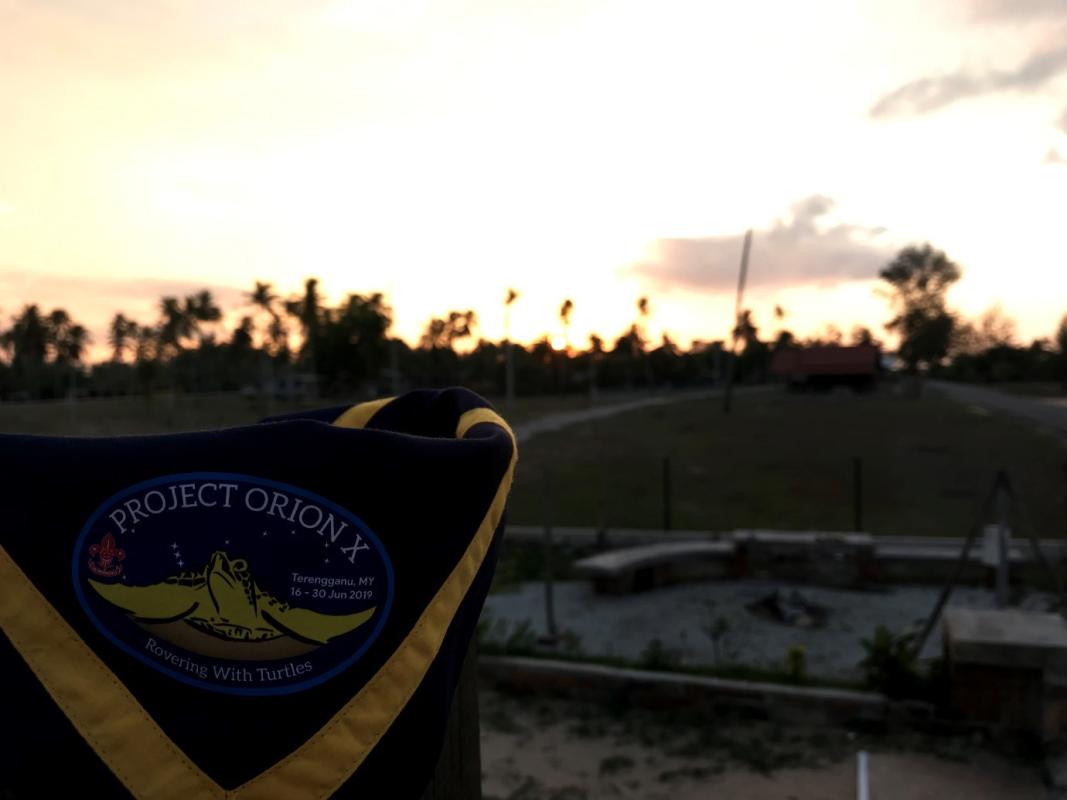

Project Orion X - Rovering with Turtles
Project Orion X – Rovering with Turtles is the tenth project in the series of annual collaborations with our host organisation, World Wide Fund for Nature (WWF) – Malaysia and Pengusaha Wanita Setiu (PEWANIS), or the Setiu Women Entrepreneurs from Kampong Mangkok.
This year (2019) marks Project Orion’s 10th Anniversary.
Initiated in 2009, Scouts from different units and background came together with a common objective of marine turtle conservation in Terengganu, Malaysia. Alongside turtle conservation work, the project also includes mangrove replanting, community/ construction works and cultural activities such as banana chip, keropok lekor (local delicacies) and wau (traditional kite) making.
Project Orion X is made up of nine Scouts and the project took place between 16 June to 30 June 2019 in Kampong Mangkok, Setiu, Terengganu, Malaysia.
Project Orion revolves around the conservation of marine turtles in Terengganu, Malaysia. Sightings of Green Turtles are seen relatively more commonly than the other species, but they are classified as an endangered species.
Marine turtle population has been declining due to human activities such as poaching of turtle eggs and fishing, where turtles are often caught as bycatch by commercial trawlers. Modernisation and rapid development of areas along the beaches result in an increased volume of human activities. This translates to more intrusive lighting, unnecessary disruptive noises and the litters and waste left by humans may accumulate and left uncleared. These factors are undesirable to female nesting turtles as it causes discomfort and prevents them from laying eggs. Female turtles will choose their nesting ground and only lay their eggs if they managed to find a safe and suitable environment, else, they’ll head back into the sea and return at a different time. (This behaviour is also known as ‘false crawl’, where female turtles come ashore but return to the sea without laying eggs.)
The Orion team conducts night beach patrolling, where sightings of female turtles coming ashore are more often at night than in the day. Female turtles have the tendency to return to the same stretch of beach where they were hatched. They can nest several times during a nesting season, but with each nesting, the number of eggs in each clutch will decrease. Each clutch of eggs can range from 120 eggs to just about 30 eggs per clutch.
The team patrols alongside rangers and WWF staffs to deter poachers from obtaining freshly laid turtle eggs, where it can be sold on the market at high prices. The team also assist the rangers and WWF staffs in excavating fresh nest for the eggs to be re-located to a hatchery where it provides protection from poachers and its natural predators – e.g. ghost crabs. (This process of excavating and re-locating the nest is also known as ‘ex-situ’ and where eggs that are left in their original nest to hatch, is known as ‘in-situ’) By doing so, it increases the number of successful hatching and thus allowing the population to have better chances of growing.
One of the patrolling team was fortunate to witness four female turtles on a single patrol, with three of them having laid its eggs. Moving the eggs requires some technical skills to avoid dis-orientating the eggs excessively and while the team needs to transport the eggs from the beach to the hatchery, the team will also have to ensure that all the eggs are accounted for during the process. The patrolling team also witnessed the removal of barnacles from the turtle’s shells and tagging of the female turtle. New turtle sightings can be identified comparing the tide level to the spot where the turtle track begins on the beach.
Green turtles’ eggs take approximately two months before they are hatched, and the number of hatchlings will be counted where it will be used during nest excavation conducted by the team about 4-5 days later. Leaving the nest for 4-5 days before excavating gives late boomers a little more time to make their way to the surface, where this climb can be essential as it is their first huddle in their life cycle.
Nest excavations are conducted to account for all the eggs. For example, where 100 eggs have been re-located into the hatchery, and 80 hatchlings were accounted for, the team conducts nest excavation to uncover the status of the remaining 20. They may include late boomers where these hatchlings are still making their way up to the surface, or they may still be a fully intact egg. Eggs can be further grouped into two categories, namely yolk or embryo. Uncovering whether the unhatched egg is a yolk, or an embryo requires the team to open the eggs. This is a saddening and emotional process of understanding whether the hatchling is half-developed, unfertilized or it has succumbed to predators or bacterial infection.
Aside from marine turtle conservation, the team took up several community/ construction work in the village that involves building extended structures such as porches for a variety of uses such as, a new room, toilets or the villager may even decide to run a start-up under the porch.
It was an eye-opening experience for the team to witness how common items such as strings and transparent tubing with water can be used to lay a solid foundation in the construction of porches. With very limited knowledge on construction, the team started off by observing how things were done by the construction foreman and gradually, they managed to handle the work by themselves from measuring height level using the transparent tube, marking the height and building the porch based on the markings.
The most daunting project for the team turned out to be the most fulfilling one. It had the tallest pillars, longest asbestos roof, the greatest number of wooden beams and planks and the most challenging terrain.
The team proceeded to assist the construction foreman, who is also a villager, in marking out the placement for the pillars. Using strings, the team formed a rectangular perimeter where the pillars will align nicely on the inner right corners of the rectangle. As the base of the pillars will have to sit in a pit for structural stability, the team continued by digging a pit just under the right-angle corners marked by the strings.
Moving the concrete pillars into place was challenging due to the terrain and weight of the pillar. The team had to shift it into place such that it aligns nicely with the string marking and using a spirit level to ensure that the pillar is levelled.
Ladders were brought in to make up for the height difference as the team had to move the wooden beams and asbestos roofs to the tip of the pillar to be secured. Layers of wooden beams, nailed one on top of another, creating a total of three layers before the asbestos roof could be laid and nailed down.
The team also got the opportunity to practice their sawing skills while some got to perform some hammering work. In other construction projects, the team got to mix cement powder to get cement that is poured into a similar pit to provide a better foundation for the porch.
My Orion journey started in 2014 after a residential Scouts of the World Discovery – workshop, where I was introduced to the Project Orion series and in June that year, I participated in Project Orion V.
This year is my third visit to Kampong Mangkok and I’m still excited for the next. This village remains a great place to escape the noisy and face-paced city life. We open our accommodation’s doors to the sound of waves meeting the shores and not a city waking for yet another day of hustle and bustle. We start every day with a spectacular view of the sunrise just on the front porch of our accommodation and sunset at our backyard.
This made me see the value of slowing down our paces (in face-paced city life), to better appreciate the little things in our everyday.
More importantly are the work done by the team for a better tomorrow and a better future, although we can only really see the impact on the marine turtle population many years down this journey. Regardless, the team strives to create positive changes in the community and in Creating a Better World.
Every Orion is an adventure with its unique and outstanding members, and Orion Team X is no different. This trip has provided me with many opportunities to experience encounters that I did not chance upon from past trips and the team made it even more memorable and precious.
Thank you Team X!


