
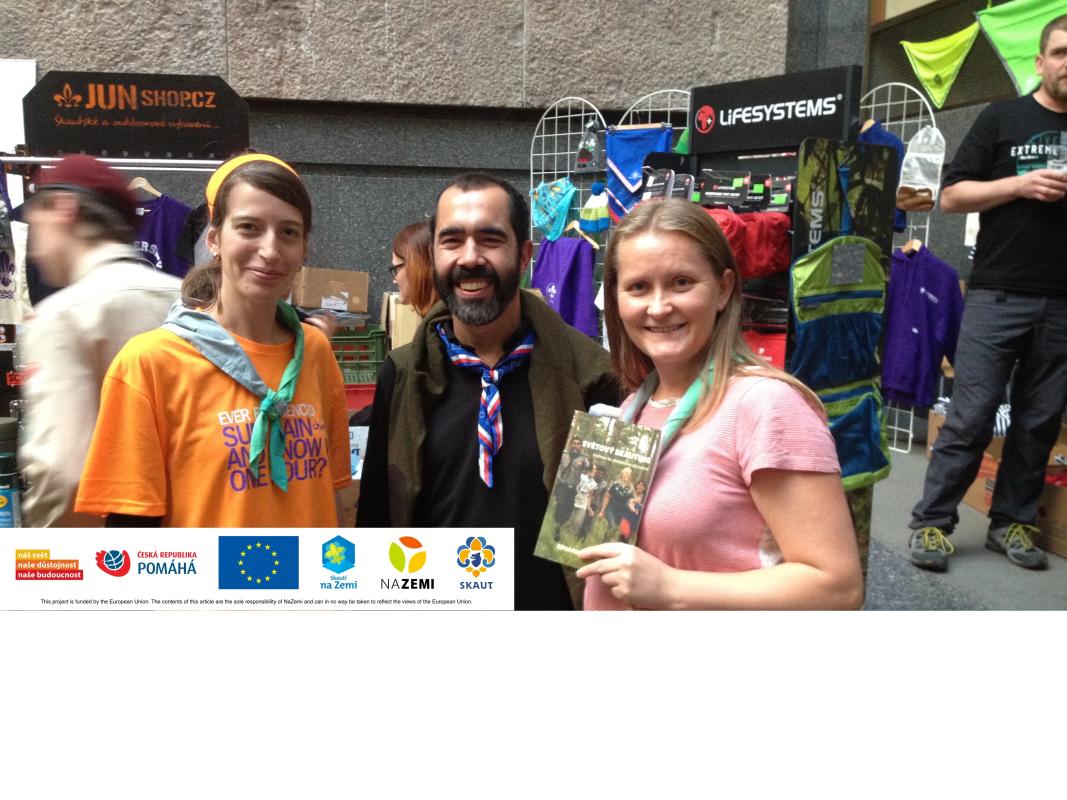

Values of Scouting are stronger than organization - Interview with Eduard Vallory
With Eduard Vallory, the author of the book “World Scouting”, about two scout identities enhancing the sense of belonging to the world and impartial involvement.
After entering the café in the Municipal Library of Prague, a bearded Catalan, wrapped in a scarf, talks about his excitement about the city and he complains about the weather here, too cold for him. Then he talks enthusiastically about this year’s St. Nikolas Seminar with the topic How to improve the world, where he was one of the lecturers. We order two black teas and our interview can start.
How would you describe your profession?
I graduated in political science but I see myself first of all as a social analyst. Political science deals with organizations, processes, electoral systems. I am especially interested in analysis of movements, like scouting for instance, and in how they work inside.
What was your wide-ranging research of scouting focused on?
My first question was how to connect our national identity with the fact that we belong to a global community at the same time. In scouting, there both the identities meet – when you go to the World Jamboree, for example. What makes scouting interesting for me is this unique thing that both these identities meet and both bring enrichment. Chief of World Organization of the Scout Movement (WOSM) told me that nobody had ever researched scouting as a global movement. Sometimes it is not even clear what scouting really is. What does scouting in Korea, Malaysia, Senegal, The Czech Republic, Argentina, or Fiji have in common? It is a movement with enormous cultural diversity as it works all over the world. How many languages does scouting have? The languages are tricky because translations sometimes can change the concept. For instance, there is no expression for the word leadership in French, and no word for laicite in English. Something disappears during translations. How would you cope with the research of the movement that supposed to share similar values worldwide, while you do not know whether some key words mean the same thing? I was trying to analyze this fact when I researched scouting as a world, global movement. We know only our Czech or Catalan reality of scouting but it is sufficient for describing the situation in other countries.
What were the most interesting findings for you?
The fact, that scouting was more important as a movement, not as an organization in the past. It was then that we could understand why scouting is so important for fighting against discrimination. It formed citizens who were not indifferent to it. Organization is necessarily still in connection with public institutions and power structures, movement lives according to shared values. What was happening in African countries colonized by the British, or race discrimination in the USA can serve as an example. One realizes that the power of scouting lies in its values that are stronger than organization. I’ll give an example to explain that. In the USA of the 50th, race segregation was legal there – what a scout is supposed to do? Should he oppose, or should he do nothing? An organization tends to see that it is legal and so it is all right, a movement, on the other hand, is formed by individuals, and the individuals believe that people of different skin colour are equal. Critical thinking and a will to oppose discrimination are activated. In spite of the fact it is accepted by an organization. In America also gays were discriminated by an organization, but many individuals opposed that because it is against the values of scouting.
To which measure scouts are supposed to be loyal to their country? When is it right and when it is not?
This is exactly why distinguishing between organization and movement is interesting. Both layers of our identity - national and global – play their roles again. Scouting works with the idea of nation, which can be powerful if used positively. Religion is also important in many countries. Nation and religion are crucial for creating society. But they can also be used for discrimination and dominance. We are better because we are Czechs, Christians etc. That is why belonging together with the global community is not additional, on the contrary, it is essential as it teaches us to see and to respect other nations and religions, too, and it leads to enriching exchange. We can’t say we are more important than others. This can be seen at any international scout activity. Even if you do not leave the Czech Republic you know there are scouts in Korea who share values of respect, and they long for the world where people can live in peace. This is a safeguard against nationalism and supremacy because of religion. The scout organization is in relation with establishment, but the scout movement is not as it is composed of individuals who, first of all, respect values. In case the establishment is against the scout values, the individuals of the movement can influence the organization or leave it. It has happened many times during recent hundred years. Organization is a part of status quo, the movement, however, ensures the status quo can be called into question or changed.
What differences in the conception of scouting across the world have you noticed?
Scouting in the world can be defined by four points. The first one is the purpose: why does it exist? It is here to help develop young people, develop their potential as humans and citizens on a local, national and global level. This is shared everywhere. The second point is the values, for instance, coexistence, which is a scout law, or three basic principles: values towards you as a human being, as a member of society, and also as a part of something much bigger, spiritual. There are individual, social and spiritual values. Scouts law and inclusive values are being described in different ways in different parts of the world. In Malaysia, for example, it is stated differently from this country. What do they have in common then? The fact that they are inclusive, they are about coexistence and doing no harm. None of the scout values can be used for doing any harm. You are honest, you make an effort, you respect others, love the nature and your country. But whenever the values are used to do harm to anyone or to hate others, it means that they were entirely misunderstood. The third point is the methodology. It is not what you see, but the sense of what you see. The methodology enhances positive values in young people, love to the nature, it is based on the idea ‘learning by doing’ as scouting is not a theoretical movement, it teaches people to be self-reliant. It is the purpose, not the way how you get there. A neckerchief, uniform, T-shirt, hat, shoes could serve as a symbolic frame. All that we can use to recognize each other but it’s not a heart of the thing. The forth point is the movement character. It is open to everyone, it’s voluntary, spending your leisure time. These four points can be found everywhere, even though their form can differ slightly. However, if scouting is applied to spread intolerance, or if it is just as a channel to pass information to children, or it doesn’t leave space for a discussion, something is wrong then.
What could a group encouraging an active global citizenship look like?
In summer, a group of 20 people is going for a two-week camp and the question is how they will manage to put in practice the values we spoke about. What would happen if one third of the group languished? What would happen if some girls were harassed? What if somebody was beaten up? What if somebody’s tent was on fire? People would react somehow. They wouldn’t stay in their tent, in safety if something like that happened near them. They wouldn’t think: it is not my business. And that is what an active citizenship and community care is about. A citizen is a member of the community, so he has duties, too. Many people may realize this for the first time right in the camp. I won’t be indifferent to other people’s suffering although I will have to put some effort into in. This can be developed in many levels – in your town, in your country and worldwide as well. The national identity is quite new, about 200 hundred years, but it helps feel closeness towards some people. Let’s say you are in Japan and there earthquake occurs. You hear a woman calling in Czech. Do you feel closer to this woman than to others around? The only reason is that you use the same language, which is a strong tool of national identity. Much harder is to act with solidarity towards other nations and the rest of the world. This is a thing scouting can offer to the world. You know that people are dying in Japan, Syria, Lebanon or Africa. However, you have met local scouts at an international event and so it is not that distant for you. B.P. said after World War I that scouting should connect people and prevent new wars. If you have friends in foreign countries, you can’t wish to fight against them. The great challenge of today is that people do not view the whole world as a community. Personal experience can help that. A camp experience, for instance, an experience of helping at places affected by earthquake or taking part in development coordination. It can help scouts to understand that right the same commitments to other scouts we also have towards all the mankind. The citizens’ responsibility reaches farther than within the borders of the country. The thing is we can’t learn or explain values and attitudes, we must experience it. The Power-point can’t solve bullying at school. Similarly we will not understand holocaust watching a Power-point presentation. We need personal experience and then it is possible to change stereotypes in thinking. Scouting is helping that, and that is why the movement is very important for global citizenship.
How can we imagine togetherness with the world?
It is more than solidarity with the world. If you sense you belong into a global community, and there is a conflict in Syria, you do not perceive it as if it is happening to someone else. It alarms you and you feel it is your concern, too. And you will do what is within your power. I believe this international dimension of scouting is really crucial.
Do you suggest that scouts would hold social protests against what they don’t like?
A balance is needed between trying to achieve fulfilling the values you appreciate, and opportunity for children to have their own opinion and make their decision. It is hard to achieve. You do not wish to boss them around to do something without thinking. On the other hand, you do not want to stay passive and indifferent. My piece of advice would be to find a common basis and not to start a political and party fighting. In a group, it is possible to look for a consensus. Scouting is an educational movement, so in case we protest, we also use it for educational purposes but we do not make decisions instead of children. Let’s be activists in topics with a wide consensus, for instance, Aims for sustainable development. It is something people generally agree on, but countries do not fulfill them. You can tell the government they have commitments, and they do not keep them. We agreed on lowering emissions and we do not follow it. Politically controversial issues can be problematic. We can be activists, however, even in problems without a general consensus, but they are close to your values, like xenophobia, racism, discrimination. If somebody, for example, burns houses of people worshipping another god, maybe an elephant one, I will go and tell him not to burn the houses. Activism is a great tool for education but it must be used together with critical thinking and with legacy to our values. We should bear in mind that it is always wrong to beat someone just because he has a different colour of skin.
The scout organization performs as apolitical. Is it possible to remain apolitical, with such subject?
That is just the reason why I spoke about apolitical engagement. It means you are not a part of a political party. If you take a stand on, let’s say, climatic change, it obviously is political. If you hold an opinion on Syrian refugees, it is entirely political. If you employ yourself against xenophobia or minority discrimination, there again you act politically. The question is how to take political stands and leave space for others of the movement to decide themselves. Sometimes there is no choice. Discrimination is never acceptable. In my country, discrimination of homosexuals in scouting is unacceptable, but in the USA, for example, there are many people who agree with it. What to do with it? Let’s go back to the difference between organization and movement. Movement is changing quicker and it can influence the organization. The question is how to be political and not enter political parties fighting. We should build on consensus. Global citizenship is entirely connected with supporting Aims for sustainable development. It is a document signed by government representatives. Engagement is then a tool for education. The spirit of the movement controls the organization and shifts it.
You have finished the research on scouting. What are you engaged in now?
Now I work with a Catalan organization that re-organizes local educational system. It tries to create active schools in which children are not passive receivers of information but they work with their attitudes, values, and they get the skills needed for their orientation in the quickly changing world.
Gallery


